Biography
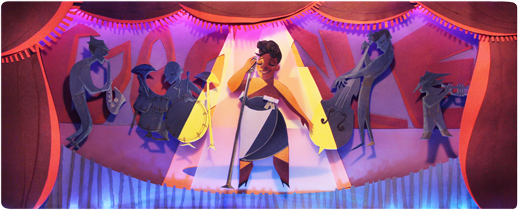
Dubbed "The First Lady of Song," Ella Fitzgerald was the most popular female jazz singer in the United States for more than half a century. In her lifetime, she won 13 Grammy awards and sold over 40 million albums.
Her voice was flexible, wide-ranging, accurate and ageless. She could sing sultry ballads, sweet jazz and imitate every instrument in an orchestra. She worked with all the jazz greats, from Duke Ellington, Count Basie and Nat King Cole, to Frank Sinatra, Dizzy Gillespie and Benny Goodman. (Or rather, some might say all the jazz greats had the pleasure of working with Ella.)
She performed at top venues all over the world, and packed them to the hilt. Her audiences were as diverse as her vocal range. They were rich and poor, made up of all races, all religions and all nationalities. In fact, many of them had just one binding factor in common - they all loved her.
Humble but happy beginnings
Ella Jane Fitzgerald was born in Newport News, Va. on April 25, 1917. Her father, William, and mother, Temperance (Tempie), parted ways shortly after her birth. Together, Tempie and Ella went to Yonkers, N.Y, where they eventually moved in with Tempie's longtime boyfriend Joseph Da Silva. Ella's half-sister, Frances, was born in 1923 and soon she began referring to Joe as her stepfather.
To support the family, Joe dug ditches and was a part-time chauffeur, while Tempie worked at a laundromat and did some catering. Occasionally, Ella took on small jobs to contribute money as well. Perhaps naïve to the circumstances, Ella worked as a runner for local gamblers, picking up their bets and dropping off money.
Their apartment was in a mixed neighborhood, where Ella made friends easily. She considered herself more of a tomboy, and often joined in the neighborhood games of baseball. Sports aside, she enjoyed dancing and singing with her friends, and some evenings they would take the train into Harlem and watch various acts at the Apollo Theater.
A rough patch
In 1932, Tempie died from serious that injuries she received in a car accident. Ella took the loss very hard. After staying with Joe for a short time, Tempie's sister Virginia took Ella home. Shortly afterward Joe suffered a heart attack and died, and her little sister Frances joined them.
Unable to adjust to the new circumstances, Ella became increasingly unhappy and entered into a difficult period of her life. Her grades dropped dramatically, and she frequently skipped school. After getting into trouble with the police, she was taken into custody and sent to a reform school. Living there was even more unbearable, as she suffered beatings at the hands of her caretakers.
Eventually Ella escaped from the reformatory. The 15-year-old found herself broke and alone during the Great Depression, and strove to endure.
Never one to complain, Ella later reflected on her most difficult years with an appreciation for how they helped her to mature. She used the memories from these times to help gather emotions for performances, and felt she was more grateful for her success because she knew what it was like to struggle in life.
"What's she going to do?"
In 1934 Ella's name was pulled in a weekly drawing at the Apollo and she won the opportunity to compete in Amateur Night. Ella went to the theater that night planning to dance, but when the frenzied Edwards Sisters closed the main show, Ella changed her mind. "They were the dancingest sisters around," Ella said, and she felt her act would not compare.
Once on stage, faced with boos and murmurs of "What's she going to do?" from the rowdy crowd, a scared and disheveled Ella made the last minute decision to sing. She asked the band to play Hoagy Carmichael's "Judy," a song she knew well because Connee Boswell's rendition of it was among Tempie's favorites. Ella quickly quieted the audience, and by the song's end they were demanding an encore. She obliged and sang the flip side of the Boswell Sister's record, "The Object of My Affections."
Off stage, and away from people she knew well, Ella was shy and reserved. She was self-conscious about her appearance, and for a while even doubted the extent of her abilities. On stage, however, Ella was surprised to find she had no fear. She felt at home in the spotlight.
"Once up there, I felt the acceptance and love from my audience," Ella said. "I knew I wanted to sing before people the rest of my life."
In the band that night was saxophonist and arranger Benny Carter. Impressed with her natural talent, he began introducing Ella to people who could help launch her career. In the process he and Ella became lifelong friends, often working together.
Fueled by enthusiastic supporters, Ella began entering - and winning - every talent show she could find. In January 1935 she won the chance to perform for a week with the Tiny Bradshaw band at the Harlem Opera House. It was there that Ella first met drummer and bandleader Chick Webb. Although her voice impressed him, Chick had already hired male singer Charlie Linton for the band. He offered Ella the opportunity to test with his band when they played a dance at Yale University.
"If the kids like her," Chick said, "she stays."
Despite the tough crowd, Ella was a major success, and Chick hired her to travel with the band for $12.50 a week.
Jazzing things up
In mid 1936, Ella made her first recording. "Love and Kisses" was released under the Decca label, with moderate success. By this time she was performing with Chick's band at the prestigious Harlem's Savoy Ballroom, often referred to as "The World's Most Famous Ballroom."
Shortly afterward, Ella began singing a rendition of the song, "(If You Can't Sing It) You Have to Swing It." During this time, the era of big swing bands was shifting, and the focus was turning more toward bebop. Ella played with the new style, often using her voice to take on the role of another horn in the band. "You Have to Swing It" was one of the first times she began experimenting with scat singing, and her improvisation and vocalization thrilled fans. Throughout her career, Ella would master scat singing, turning it into a form of art.
In 1938, at the age of 21, Ella recorded a playful version of the nursery rhyme, "A-Tisket, A-Tasket." The album sold 1 million copies, hit number one, and stayed on the pop charts for 17 weeks. Suddenly, Ella Fitzgerald was famous.
Coming into her own
On June 16, 1939, Ella mourned the loss of her mentor Chick Webb. In his absence the band was renamed "Ella Fitzgerald and Her Famous Band," and she took on the overwhelming task of bandleader.
Perhaps in search of stability and protection, Ella married Benny Kornegay, a local dockworker who had been pursuing her. Upon learning that Kornegay had a criminal history, Ella realized that the relationship was a mistake and had the marriage annulled.
While on tour with Dizzy Gillespie's band in 1946, Ella fell in love with bassist Ray Brown. The two were married and eventually adopted a son, whom they named Ray, Jr.
At the time, Ray was working for producer and manager Norman Granz on the "Jazz at the Philharmonic" tour. Norman saw that Ella had what it took to be an international star, and he convinced Ella to sign with him. It was the beginning of a lifelong business relationship and friendship.
Under Norman's management, Ella joined the Philharmonic tour, worked with Louis Armstrong on several albums and began producing her infamous songbook series. From 1956-1964, she recorded covers of other musicians' albums, including those by Cole Porter, Duke Ellington, the Gershwins, Johnny Mercer, Irving Berlin, and Rodgers and Hart. The series was wildly popular, both with Ella's fans and the artists she covered.
"I never knew how good our songs were until I heard Ella Fitzgerald sing them," Ira Gershwin once remarked.
Ella also began appearing on television variety shows. She quickly became a favorite and frequent guest on numerous programs, including "The Bing Crosby Show," "The Dinah Shore Show," "The Frank Sinatra Show," "The Ed Sullivan Show," "The Tonight Show," "The Nat King Cole Show," "The Andy Willams Show" and "The Dean Martin Show."
Due to a busy touring schedule, Ella and Ray were often away from home, straining the bond with their son. Ultimately, Ray Jr. and Ella reconnected and mended their relationship.
"All I can say is that she gave to me as much as she could," Ray, Jr. later said, "and she loved me as much as she could."
Unfortunately, busy work schedules also hurt Ray and Ella's marriage. The two divorced in 1952, but remained good friends for the rest of their lives.
Overcoming discrimination
On the touring circuit it was well-known that Ella's manager felt very strongly about civil rights and required equal treatment for his musicians, regardless of their color. Norman refused to accept any type of discrimination at hotels, restaurants or concert halls, even when they traveled to the Deep South.
Once, while in Dallas touring for the Philharmonic, a police squad irritated by Norman's principles barged backstage to hassle the performers. They came into Ella's dressing room, where band members Dizzy Gillespie and Illinois Jacquet were shooting dice, and arrested everyone.
"They took us down," Ella later recalled, "and then when we got there, they had the nerve to ask for an autograph."
Norman wasn't the only one willing to stand up for Ella. She received support from numerous celebrity fans, including a zealous Marilyn Monroe.
"I owe Marilyn Monroe a real debt," Ella later said. "It was because of her that I played the Mocambo, a very popular nightclub in the '50s. She personally called the owner of the Mocambo, and told him she wanted me booked immediately, and if he would do it, she would take a front table every night. She told him - and it was true, due to Marilyn's superstar status - that the press would go wild. The owner said yes, and Marilyn was there, front table, every night. The press went overboard. After that, I never had to play a small jazz club again. She was an unusual woman - a little ahead of her times. And she didn't know it."
Worldwide recognition
Ella continued to work as hard as she had early on in her career, despite the ill effects on her health. She toured all over the world, sometimes performing two shows a day in cities hundreds of miles apart. In 1974, Ella spent a legendary two weeks performing in New York with Frank Sinatra and Count Basie. Still going strong five years later, she was inducted into the Down Beat magazine Hall of Fame, and received Kennedy Center Honors for her continuing contributions to the arts.
Outside of the arts, Ella had a deep concern for child welfare. Though this aspect of her life was rarely publicized, she frequently made generous donations to organizations for disadvantaged youths, and the continuation of these contributions was part of the driving force that prevented her from slowing down. Additionally, when Frances died, Ella felt she had the additional responsibilities of taking care of her sister's family.
In 1987, United States President Ronald Reagan awarded Ella the National Medal of Arts. It was one of her most prized moments. France followed suit several years later, presenting her with their Commander of Arts and Letters award, while Yale, Dartmouth and several other universities bestowed Ella with honorary doctorates.
End of an era
In September of 1986, Ella underwent quintuple coronary bypass surgery. Doctors also replaced a valve in her heart and diagnosed her with diabetes, which they blamed for her failing eyesight. The press carried rumors that she would never be able to sing again, but Ella proved them wrong. Despite protests by family and friends, including Norman, Ella returned to the stage and pushed on with an exhaustive schedule.
By the 1990s, Ella had recorded over 200 albums. In 1991, she gave her final concert at New York's renowned Carnegie Hall. It was the 26th time she performed there.
As the effects from her diabetes worsened, 76-year-old Ella experienced severe circulatory problems and was forced to have both of her legs amputated below the knees. She never fully recovered from the surgery, and afterward, was rarely able to perform. During this time, Ella enjoyed sitting outside in her backyard, and spending time with Ray, Jr. and her granddaughter Alice.
"I just want to smell the air, listen to the birds and hear Alice laugh," she said.
On June 15, 1996, Ella Fitzgerald died in her Beverly Hills home. Hours later, signs of remembrance began to appear all over the world. A wreath of white flowers stood next to her star on the Hollywood Walk of Fame, and a marquee outside the Hollywood Bowl theater read, "Ella, we will miss you."
After a private memorial service, traffic on the freeway was stopped to let her funeral procession pass through. She was laid to rest in the "Sanctuary of the Bells" section of the Sunset Mission Mausoleum at Inglewood Park Cemetery in Inglewood, Calif.


