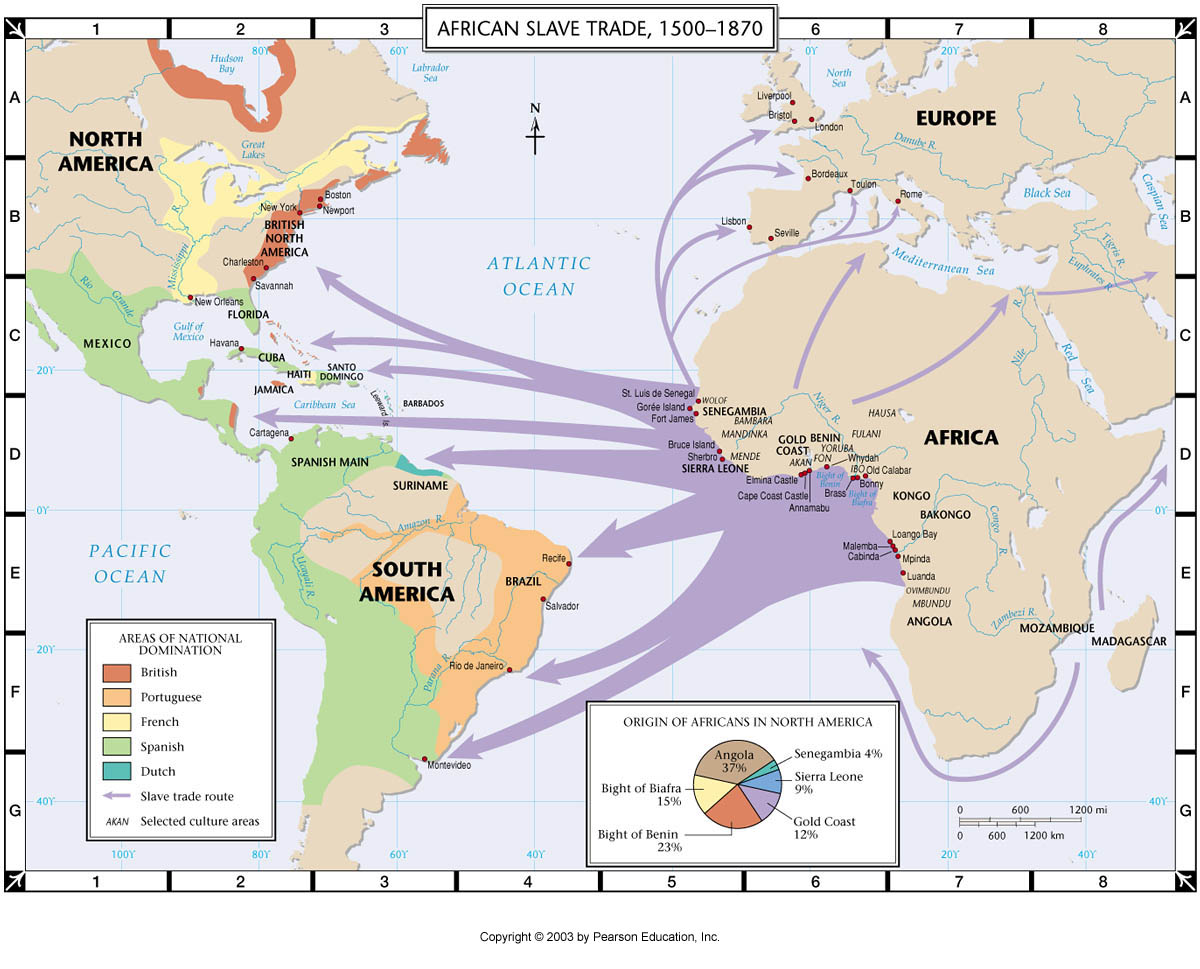
Though descendants of these enslaved Africans now make up considerable segments of the population in the United States, Brazil and many Caribbean islands, written records of their ancestors’ origins are difficult—if not impossible—to find.

In addition to the nearly 50 percent of the total number of enslaved Africans in the United States from these two regions, a considerable number of slaves had their origins on the so-called “Slave Coast,” which is now the West African nation of Ghana, as well as neighboring parts of the Windward Coast, now Ivory Coast. Others originated in the Bight of Biafra (including parts of present-day eastern Nigeria and Cameroon), an inlet of the Atlantic on Africa’s western coast that was a hub of extensive slave-dealing operations.

Through extensive research, however, scholars have been able to make educated guesses about where many of the slaves brought to the New World originated.

Slaves brought to the United States represented about 3.6 percent of the total number of Africans transported to the New World, or around 388,000 people—considerably less than the number transported to colonies in the Caribbean (including more than 1.2 million to Jamaica alone) or to Brazil (4.8 million). Of those Africans who arrived in the United States, nearly half came from two regions: Senegambia, the area comprising the Senegal and Gambia Rivers and the land between them, or today’s Senegal, Gambia, Guinea-Bissau and Mali; and west-central Africa, including what is now Angola, Congo, the Democratic Republic of Congo and Gabon. The Gambia River, running from the Atlantic into Africa, was a key waterway for the slave trade; at its height, about one out of every six West African slaves came from this area.