Showing posts with label black men. Show all posts

Friday, July 31, 2015

Although originally projected to last 6 months, the study actually went on for 40 years.

What Went Wrong?


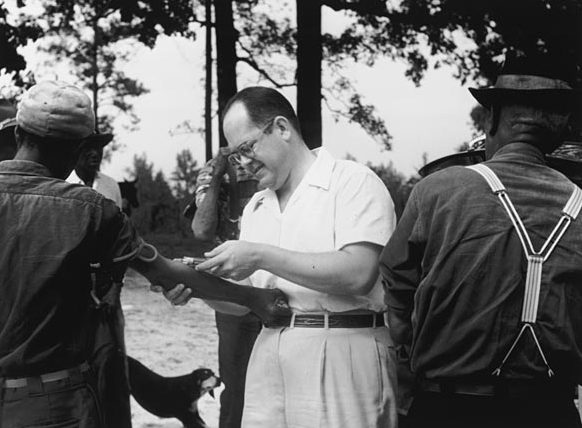
In 1932, the Public Health Service, working with the Tuskegee Institute, began a study to record the natural history of syphilis in hopes of justifying treatment programs for blacks. It was called the "Tuskegee Study of Untreated Syphilis in the Negro Male."
The study initially involved 600 black men – 399 with syphilis, 201 who did not have the disease. The study was conducted without the benefit of patients' informed consent. Researchers told the men they were being treated for "bad blood," a local term used to describe several ailments, including syphilis, anemia, and fatigue. In truth, they did not receive the proper treatment needed to cure their illness. In exchange for taking part in the study, the men received free medical exams, free meals, and burial insurance. Although originally projected to last 6 months, the study actually went on for 40 years.

In July 1972, an Associated Press story about the Tuskegee Study caused a public outcry that led the Assistant Secretary for Health and Scientific Affairs to appoint an Ad Hoc Advisory Panel to review the study. The panel had nine members from the fields of medicine, law, religion, labor, education, health administration, and public affairs.
The panel found that the men had agreed freely to be examined and treated. However, there was no evidence that researchers had informed them of the study or its real purpose. In fact, the men had been misled and had not been given all the facts required to provide informed consent.
The men were never given adequate treatment for their disease. Even when penicillin became the drug of choice for syphilis in 1947, researchers did not offer it to the subjects. The advisory panel found nothing to show that subjects were ever given the choice of quitting the study, even when this new, highly effective treatment became widely used.

Tuesday, August 20, 2013

John Lewis, "Speech at the March on Washington" August 28, 1963

John Lewis U.S. Rep. John Lewis (D-GA) (R) is presented with the 2010 Medal of Freedom by President Barack Obama during an East Room event at the White House February 15, 2011 in Washington, DC. Obama presented the medal, the highest honor awarded to civilians, to twelve pioneers in sports, labor, politics and arts.
JOHN LEWIS, “SPEECH AT THE MARCH ON WASHINGTON” (28 AUGUST 1963)
[1] We march today for jobs and freedom, but we have nothing to be proud of.  For hundreds and thousands of our brothers are not here.  For they are receiving starvation wages, or no wages at all.  While we stand here, there are sharecroppers in the Delta of Mississippi who are out in the fields working for less than three dollars a day, twelve hours a day.  While we stand here there are students in jail on trumped-up charges.  Our brother James Farmer, along with many others, is also in jail. We come here today with a great sense of misgiving.
[2] It is true that we support the administration’s civil rights bill.  We support it with great reservations, however.  Unless Title III is put in this bill, there is nothing to protect the young children and old women who must face police dogs and fire hoses in the South while they engage in peaceful demonstrations.  In its present form, this bill will not protect the citizens of Danville, Virginia, who must live in constant fear of a police state.  It will not protect the hundreds and thousands of people that have been arrested on trumped charges.  What about the three young men, SNCC field secretaries in Americus, Georgia, who face the death penalty for engaging in peaceful protest?
[3] As it stands now, the voting section of this bill will not help the thousands of black people who want to vote.  It will not help the citizens of Mississippi, of Alabama and Georgia, who are qualified to vote, but lack a sixth-grade education.  “One man, one vote” is the African cry.  It is ours too.  It must be ours!
[4] We must have legislation that will protect the Mississippi sharecropper who is put off of his farm because he dares to register to vote.  We need a bill that will provide for the homeless and starving people of this nation.  We need a bill that will ensure the equality of a maid who earns five dollars a week in a home of a family whose total income is $100,000 a year.  We must have a good FEPC bill.
[5] My friends, let us not forget that we are involved in a serious social revolution.  By and large, American politics is dominated by politicians who build their careers on immoral compromises and ally themselves with open forms of political, economic, and social exploitation.  There are exceptions, of course.  We salute those.  But what political leader can stand up and say, “My party is the party of principles”?  For the party of Kennedy is also the party of Eastland.  The party of Javits is also the party of Goldwater.  Where is our party?  Where is the political party that will make it unnecessary to march on Washington?
[6] Where is the political party that will make it unnecessary to march in the streets of Birmingham?  Where is the political party that will protect the citizens of Albany, Georgia?  Do you know that in Albany, Georgia, nine of our leaders have been indicted, not by the Dixiecrats, but by the federal government for peaceful protest?  But what did the federal government do when Albany’s deputy sheriff beat Attorney C.B. King and left him half-dead?  What did the federal government do when local police officials kicked and assaulted the pregnant wife of Slater King, and she lost her baby?
[7] To those who have said, “Be patient and wait,” we have long said that we cannot be patient.  We do not want our freedom gradually, but we want to be free now!  We are tired.  We are tired of being beaten by policemen.  We are tired of seeing our people locked up in jail over and over again.  And then you holler, “Be patient.”  How long can we be patient?  We want our freedom and we want it now.  We do not want to go to jail.  But we will go to jail if this is the price we must pay for love, brotherhood, and true peace.
[8] I appeal to all of you to get into this great revolution that is sweeping this nation.  Get in and stay in the streets of every city, every village and hamlet of this nation until true freedom comes, until the revolution of 1776 is complete.  We must get in this revolution and complete the revolution.  For in the Delta in Mississippi, in southwest Georgia, in the Black Belt of Alabama, in Harlem, in Chicago, Detroit, Philadelphia, and all over this nation, the black masses are on the march for jobs and freedom.
[9] They’re talking about slow down and stop.  We will not stop.  All of the forces of Eastland, Barnett, Wallace, and Thurmond will not stop this revolution.  If we do not get meaningful legislation out of this Congress, the time will come when we will not confine our marching to Washington.  We will march through the South; through the streets of Jackson, through the streets of Danville, through the streets of Cambridge, through the streets of Birmingham.  But we will march with the spirit of love and with the spirit of dignity that we have shown here today.  By the force of our demands, our determination, and our numbers, we shall splinter the segregated South into a thousand pieces and put them together in the image of God and democracy.  We must say: “Wake up America!  Wake up!”  For we cannot stop, and we will not and cannot be patient. 

Monday, July 15, 2013

Happpy Birthday-Mrs. Ida B. Wells

CHAPTER VI. SELF HELP Of the many inhuman outrages of this present year, the only case where the proposed lynching did not occur, was where the men armed themselves in Jacksonville, Fla., and Paducah, Ky., and prevented it. The only times an Afro-American who was assaulted got away has been when he had a gun and used it in self-defense.
The lesson this teaches and which every Afro American should ponder well, is that a Winchester rifle should have a place of honor in every black home, and it should be used for that protection which the law refuses to give. When the white man who is always the aggressor knows he runs as great a risk of biting the dust every time his Afro-American victim does, he will have greater respect for Afro-American life. The more the Afro-American yields and cringes and begs, the more he has to do so, the more he is insulted, outraged and lynched.
Ida B. Wells
Southern Horrors. Lynch Law in All Its Phases, 1892

…It is with no pleasure I have dipped my hands in the corruption here exposed. Somebody must show that the Afro-American race is more sinned against than sinning, and it seems to have fallen upon me to do so. The awful death-roll that Judge Lynch is calling every week is appalling, not only because of the lives it takes, the rank cruelty and outrage to the victims, but because of the prejudice it fosters and the stain it places against the good name of a weak race.
The Afro-American is not a bestial race. If this work can contribute in any way toward proving this, and at the same time arouse the conscience of the American people to a demand for justice to every citizen, and punishment by law for the lawless, I shall feel I have done my race a service. Other considerations are of minor importance.
New York City, Oct. 26, 1892. IDA B. WELLS.
HON. FRED. DOUGLASS'S LETTER
Dear Miss Wells:
Let me give you thanks for your faithful paper on the lynch abomination now generally practiced against colored people in the South. There has been no word equal to it in convincing power. I have spoken, but my word is feeble in comparison. You give us what you know and testify from actual knowledge. You have dealt with the facts with cool, painstaking fidelity and left those naked and uncontradicted facts to speak for themselves.
Brave woman! you have done your people and mine a service which can neither be weighed nor measured. If American conscience were only half alive, if the American church and clergy were only half christianized, if American moral sensibility were not hardened by persistent infliction of outrage and crime against colored people, a scream of horror, shame and indignation would rise to Heaven wherever your pamphlet shall be read.
But alas! even crime has power to reproduce itself and create conditions favorable to its own existence. It sometimes seems we are deserted by earth and Heaven--yet we must still think, speak and work, and trust in the power of a merciful God for final deliverance.
Very truly and gratefully yours,
FREDERICK DOUGLASS.
Cedar Hill, Anacostia, D.C., Oct. 25, 1892.


CHAPTER I. THE OFFENSE
Wednesday evening May 24th, 1892, the city of Memphis was filled with excitement. Editorials in the daily papers of that date caused a meeting to be held in the Cotton Exchange Building; a committee was sent for the editors of the "Free Speech" an Afro-American journal published in that city, and the only reason the open threats of lynching that were made were not carried out was because they could not be found. The cause of all this commotion was the following editorial published in the "Free Speech" May 21st, 1892, the Saturday previous.
"Eight negroes lynched since last issue of the 'Free Speech' one at Little Rock, Ark., last Saturday morning where the citizens broke (?)[A] into the penitentiary and got their man; three near Anniston, Ala., one near New Orleans; and three at Clarksville, Ga., the last three for killing a white man, and five on the same old racket—the new alarm about raping white women. The same programme of hanging, then shooting bullets into the lifeless bodies was carried out to the letter.
Nobody in this section of the country believes the old thread bare lie that Negro men rape white women. If Southern white men are not careful, they will over-reach themselves and public sentiment will have a reaction; a conclusion will then be reached which will be very damaging to the moral reputation of their women."

The editorial in question was prompted by the many inhuman and fiendish lynchings of Afro-Americans which have recently taken place and was meant as a warning. Eight lynched in one week and five of them charged with rape! The thinking public will not easily believe freedom and education more brutalizing than slavery, and the world knows that the crime of rape was unknown during four years of civil war, when the white women of the South were at the mercy of the race, which is all at once charged with being a bestial one.
Since my business has been destroyed and I am an exile from home because of that editorial, the issue has been forced, and as the writer of it I feel that the race and the public generally should have a statement of the facts as they exist. They will serve at the same time as a defense for the Afro-Americans Sampsons who suffer themselves to be betrayed by white Delilahs….
CHAPTER III. THE NEW CRY
…One by one the Southern States have legally (?) disfranchised the Afro-American, and since the repeal of the Civil Rights Bill nearly every Southern State has passed separate car laws with a penalty against their infringement. The race regardless of advancement is penned into filthy, stifling partitions cut off from smoking cars. All this while, although the political cause has been removed, the butcheries of black men at Barnwell, S.C., Carrolton, Miss., Waycross, Ga., and Memphis, Tenn., have gone on; also the flaying alive of a man in Kentucky, the burning of one in Arkansas, the hanging of a fifteen year old girl in Louisiana, a woman in Jackson, Tenn., and one in Hollendale, Miss., until the dark and bloody record of the South shows 728 Afro-Americans lynched during the past 8 years. Not 50 of these were for political causes; the rest were for all manner of accusations from that of rape of white women, to the case of the boy Will Lewis who was hanged at Tullahoma, Tenn., last year for being drunk and "sassy" to white folks.
These statistics compiled by the Chicago "Tribune" were given the first of this year (1892). Since then, not less than one hundred and fifty have been known to have met violent death at the hands of cruel bloodthirsty mobs during the past nine months.
To palliate this record (which grows worse as the Afro-American becomes intelligent) and excuse some of the most heinous crimes that ever stained the history of a country, the South is shielding itself behind the plausible screen of defending the honor of its women. This, too, in the face of the fact that only one-third of the 728 victims to mobs have been charged with rape, to say nothing of those of that one-third who were innocent of the charge. A white correspondent of the Baltimore Sun declares that the Afro-American who was lynched in Chestertown, Md., in May for assault on a white girl was innocent; that the deed was done by a white man who had since disappeared. The girl herself maintained that her assailant was a white man. When that poor Afro-American was murdered, the whites excused their refusal of a trial on the ground that they wished to spare the white girl the mortification of having to testify in court.
This cry has had its effect. It has closed the heart, stifled the conscience, warped the judgment and hushed the voice of press and pulpit on the subject of lynch law throughout this "land of liberty." Men who stand high in the esteem of the public for christian character, for moral and physical courage, for devotion to the principles of equal and exact justice to all, and for great sagacity, stand as cowards who fear to open their mouths before this great outrage. They do not see that by their tacit encouragement, their silent acquiescence, the black shadow of lawlessness in the form of lynch law is spreading its wings over the whole country.
Men who, like Governor Tillman, start the ball of lynch law rolling for a certain crime, are powerless to stop it when drunken or criminal white toughs feel like hanging an Afro-American on any pretext.
Even to the better class of Afro-Americans the crime of rape is so revolting they have too often taken the white man's word and given lynch law neither the investigation nor condemnation it deserved.
They forget that a concession of the right to lynch a man for a certain crime, not only concedes the right to lynch any person for any crime, but (so frequently is the cry of rape now raised) it is in a fair way to stamp us a race of rapists and desperadoes. They have gone on hoping and believing that general education and financial strength would solve the difficulty, and are devoting their energies to the accumulation of both….

CHAPTER IV. THE MALICIOUS AND UNTRUTHFUL WHITE PRESS

On March 9th, 1882, there were lynched in this same city [Memphis] three of the best specimens of young since-the-war Afro-American manhood. They were peaceful, law-abiding citizens and energetic business men.
They believed the problem was to be solved by eschewing politics and putting money in the purse. They owned a flourishing grocery business in a thickly populated suburb of Memphis, and a white man named Barrett had one on the opposite corner. After a personal difficulty which Barrett sought by going into the "People's Grocery" drawing a pistol and was thrashed by Calvin McDowell, he (Barrett) threatened to "clean them out." These men were a mile beyond the city limits and police protection; hearing that Barrett's crowd was coming to attack them Saturday night, they mustered forces and prepared to defend themselves against the attack.
When Barrett came he led a posse of officers, twelve in number, who afterward claimed to be hunting a man for whom they had a warrant. That twelve men in citizen's clothes should think it necessary to go in the night to hunt one man who had never before been arrested, or made any record as a criminal has never been explained. When they entered the back door the young men thought the threatened attack was on, and fired into them. Three of the officers were wounded, and when the defending party found it was officers of the law upon whom they had fired, they ceased and got away.
Thirty-one men were arrested and thrown in jail as "conspirators," although they all declared more than once they did not know they were firing on officers. Excitement was at fever heat until the morning papers, two days after, announced that the wounded deputy sheriffs were out of danger. This hindered rather than helped the plans of the whites. There was no law on the statute books which would execute an Afro-American for wounding a white man, but the "unwritten law" did. Three of these men, the president, the manager and clerk of the grocery--"the leaders of the conspiracy"--were secretly taken from jail and lynched in a shockingly brutal manner. "The Negroes are getting too independent," they say, "we must teach them a lesson."
What lesson? The lesson of subordination. "Kill the leaders and it will cow the Negro who dares to shoot a white man, even in self defense."
Although the race was wild over the outrage, the mockery of law and justice which alarmed men and locked them up in jails where they could be easily and safely reached by the mob--the Afro-American ministers, newspapers and leaders counselled obedience to the law which did not protect them.
Their counsel was heeded and not a hand was uplifted to resent the outrage; following the advice of the "Free Speech," people left the city in great numbers.

CHAPTER V. THE SOUTH'S POSITION

…Public sentiment has had a slight "reaction" though not sufficient to stop the crusade of lawlessness and lynching. The spirit of christianity of the great M. E. Church was aroused to the frequent and revolting crimes against a weak people, enough to pass strong and condemnatory resolutions at its General Conference in Omaha last May. The spirit of justice of the grand old party asserted itself sufficiently to secure a denunciation of the wrongs, and a feeble declaration of the belief in human rights in the Republican platform at Minneapolis, June 7th. Some of the great dailies and weeklies have swung into line declaring that lynch law must go. The President of the United States [Benjamin Harrison] issued a proclamation that it be not tolerated in the territories over which he has jurisdiction. Governor Northern and Chief Justice Bleckley of Georgia have proclaimed against it. The citizens of Chattanooga, Tenn., have set a worthy example in that they not only condemn lynch law, but her public men demanded a trial for Weems, the accused rapist, and guarded him while the trial was in progress. The trial only lasted ten minutes, and Weems chose to plead guilty and accept twenty-one years sentence, than invite the certain death which awaited him outside that cordon of police if he had told the truth and shown the letters he had from the white woman in the case.
Col. A. S. Colyar, of Nashville, Tenn., is so overcome with the horrible state of affairs that he addressed the following earnest letter to the Nashville "American." "Nothing since I have been a reading man has so impressed me with the decay of manhood among the people of Tenn[e]ssee as the dastardly submission to the mob reign. We have reached the unprecedented low level; the awful criminal depravity of substituting the mob for the court and jury, of giving up the jail keys to the mob whenever they are demanded. We do it in the largest cities and in the country towns; we do it in midday; we do it after full, not to say formal, notice, and so thoroughly and generally is it acquiesced in that the murderers have discarded the formula of masks. They go into the town where everybody knows them, sometimes under the gaze of the governor, in the presence of the courts, in the presence of the sheriff and his deputies, in the presence of the entire police force, take out the prisoner, take his life, often with fiendish glee, and often with acts of cruelty and barbarism which impress the reader with a degeneracy rapidly approaching savage life. That the State is disgraced but faintly expresses the humiliation which has settled upon the once proud people of Tennessee. The State, in its majesty, through its organized life, for which the people pay liberally, makes but one record, but one note, and that a criminal falsehood, 'was hung by persons to the jury unknown.' The murder at Shelbyville is only a verification of what every intelligent man knew would come, because with a mob a rumor is as good as a proof."
These efforts brought forth apologies and a short halt, but the lynching mania was raged again through the past three months with unabated fury.
The strong arm of the law must be brought to bear upon lynchers in severe punishment, but this cannot and will not be done unless a healthy public sentiment demands and sustains such action.
The men and women in the South who disapprove of lynching and remain silent on the perpetration of such outrages, are particeps criminis [Latin for criminal participants], accomplices, accessories before and after the fact, equally guilty with the actual law-breakers who would not persist if they did not know that neither the law nor militia would be employed against them.

Friday, July 12, 2013

Frederick Douglass Discusses the meaning of the Fourth of July

Frederick Douglass Discusses the meaning of the Fourth of July
 
As the city's most distinguished resident, Frederick Douglass was requested to address the
citizens of Rochester on the Fourth of July celebration in 1852. The speech he delivered, under
the title, "What to the Slave is the Fourth of July?", illustrates the great power, insight and
integrity of the man.
Fellow Citizens:
Pardon me, and allow me to ask, why am I called upon to speak here today?
What have I or those I represent to do with your national independence? Are the great principles
of political freedom and of natural justice, embodied in that Declaration of Independence,
extended to us? And am I, therefore, called upon to bring our humble offering to the national
altar, and to confess the benefits, and express devout gratitude for the blessings resulting from
your independence to us?
Would to God, both for your sakes and ours, that an affirmative answer could be truthfully
returned to these questions. Then would my task be light, and my burden easy and delightful. For
who is there so cold that a nation's sympathy could not warm him? Who so obdurate and dead to
the claims of gratitude, that would not thankfully acknowledge such priceless benefits? Who so
stolid and selfish that would not give his voice to swell the halleluiahs of a nation's jubilee, when
the chains of servitude had been torn from his limbs? I am not that man. In a case like that, the
dumb might eloquently speak, and the "lame man leap like a hare."
But such is not the state of the case. I say it with a sad sense of disparity between us. I am not
included within the pale of this glorious anniversary! Your high independence only reveals the
immeasurable distance between us. The blessings in which you this day rejoice are not enjoyed in
common. The rich inheritance of justice, liberty, prosperity, and independence bequeathed by
your fathers is shared by you, not by me. The sunlight that brought life and healing to you has
brought stripes and death to me. This Fourth of July is
yours, not mine. You may rejoice, I must
mourn. To drag a man in fetters into the grand illuminated temple of liberty, and call upon him to
join you in joyous anthems, were inhuman mockery and sacrilegious irony. Do you mean,
citizens, to mock me, by asking me to speak today? If so, there is a parallel to your conduct. And
let me warn you, that it is dangerous to copy the example of a nation whose crimes, towering up
to heaven, were thrown down by the breath of the Almighty, burying that nation in irrecoverable
ruin. I can today take up the lament of a peeled and woe-smitten people.
"By the rivers of Babylon, there we sat down. Yes! We wept when we remembered Zion. We
hanged our harps upon the willows in the midst thereof. For there they that carried us away
captive, required of us a song; and they who wasted us, required of us mirth, saying, Sing us one
of the songs of Zion. How can we sing the Lord's song in a strange land? If I forget thee, O
Jerusalem, let my right hand forget her cunning. If I do not remember thee, let my tongue cleave
to the roof of my mouth."
Fellow citizens, above your national, tumultuous joy, I hear the mournful wail of
millions, whose chains, heavy and grievous yesterday, are today rendered more intolerable by the
jubilant shouts that reach them. If I do forget, if I do not remember those bleeding children of
sorrow this day, "may my right hand forget her cunning, and may my tongue cleave to the roof of
my mouth!" To forget them, to pass lightly over their wrongs, and to chime in with the popular
theme, would be treason most scandalous and shocking, and would make me a reproach before
God and the world. My subject, then, fellow citizens, is "American Slavery." I shall see this day
and! its popular characteristics from the slave's point of view. Standing here, identified with the
American bondman, making his wrongs mine, I do not hesitate to declare, with all my soul, that
the character and conduct of this nation never looked blacker to me than on this Fourth of July.
Whether we turn to the declarations of the past, or to the professions of the present, the conduct of
the nation seems equally hideous and revolting. America is false to the past, false to the present,
and solemnly binds herself to be false to the future. Standing with God and the crushed and
bleeding slave on this occasion, I will, in the name of humanity, which is outraged, in the name of
liberty, which is fettered, in the name of the Constitution and the Bible, which are disregarded
and trampled upon, dare to call in question and to denounce, with all the emphasis I can
command, everything that serves to perpetuate slavery-the great sin and shame of America! "I
will not equivocate; I will not excuse"; I will use the severest language I can command, and yet
not one word shall escape me that any man, whose judgment is not blinded by prejudice, or who
is not at heart a slave-holder, shall not confess to be right and just.
But I fancy I hear some of my audience say it is just in this circumstance that you and
your brother Abolitionists fail to make a favorable impression on the public mind. Would you
argue more and denounce less, would you persuade more and rebuke less, your cause would be
much more likely to succeed. But, I submit, where all is plain there is nothing to be argued. What
point in the anti-slavery creed would you have me argue? On what branch of the subject do the
people of this country need light? Must I undertake to prove that the slave is a man? That point is
conceded already. Nobody doubts it. The slave-holders themselves acknowledge it in the
enactment of laws for their government. They acknowledge it when they punish disobedience on
the part of the slave. There are seventy-two crimes in the State of Virginia, which, if committed
by a black man (no matter how ignorant he be), subject him to the punishment of death; while
only two of these same crimes will subject a white man to like punishment. What is this but the
acknowledgment that the slave is a moral, intellectual, and responsible being? The manhood of
the slave is conceded. It is admitted in the fact that Southern statute-books are covered with
enactments, forbidding, under severe fines and penalties, the teaching of the slave to read and
write. When you can point to any such laws m reference to the beasts of the field, then I may
consent to argue the manhood of the slave. When the dogs in your streets, when the fowls of the
air, when the cattle on your hills, when the fish of the sea, and the reptiles that crawl, shall be
unable to distinguish the slave from a brute, then I will argue with you that the slave is a man!
For the present it is enough to affirm the equal manhood of the Negro race. Is it not astonishing
that, while we are plowing, planting, and reaping, using all kinds of mechanical tools, erecting
houses, constructing bridges, building ships, working in metals of brass, iron, copper, silver, and
gold; that while we are reading, writing, and cyphering, acting as clerks, merchants, and
secretaries, having among us lawyers, doctors, ministers, poets, authors, editors, orators, and
teachers; that while we are engaged in all the enterprises common to other men digging gold in
California, capturing the whale in the Pacific, feeding sheep and cattle on the hillside, living,
moving, acting, thinking, planning, living in families as husbands, wives, and children, and above
all, confessing and worshipping the Christian God, and looking hopefully for life and immortality
beyond the grave-we are called upon to prove that we are men?
Would you have me argue that man is entitled to liberty? That he is the rightful owner of his own
body? You have already declared it. Must I argue the wrongfulness of slavery? Is that a question
for republicans? Is it to be settled by the rules of logic and argumentation, as a matter beset with
great difficulty, involving a doubtful application of the principle of justice, hard to understand?
How should I look today in the presence of Americans, dividing and subdividing a discourse, to
show that men have a natural right to freedom, speaking of it relatively and positively, negatively
and affirmatively? To do so would be to make myself ridiculous, and to offer an insult to your
understanding. There is not a man beneath the canopy of heaven who does not know that slavery
is wrong
for him.
What! Am I to argue that it is wrong to make men brutes, to rob them of their liberty, to work
them without wages, to keep them ignorant of their relations to their fellow men, to beat them
with sticks, to flay their flesh with the last, to load their limbs with irons, to hunt them with dogs,
to sell them at auction, to sunder their families, to knock out their teeth, to burn their flesh, to
starve them into obedience and submission to their masters? Must I argue that a system thus
marked with blood and stained with pollution is wrong? No; I will not. I have better employment
for my time and strength than such arguments would imply.
What, then, remains to be argued? Is it that slavery is not divine; that God did not establish it; that
our doctors of divinity are mistaken? There is blasphemy in the thought. That which is inhuman
cannot be divine. Who can reason on such a proposition? They that can, may; I cannot. The time
for such argument is past.
At a time like this, scorching irony, not convincing argument, is needed. Oh! had I the ability, and
could I reach the nation's ear, I would today pour out a fiery stream of biting ridicule, blasting
reproach, withering sarcasm, and stern rebuke. For it is not light that is needed, but fire; it is not
the gentle shower, but thunder. We need the storm, the whirlwind, and the earthquake. The
feeling of the nation must be quickened; the conscience of the nation must be roused; the
propriety of the nation must be startled; the hypocrisy of the nation must be exposed; and its
crimes against God and man must be denounced.
What to the American slave is your Fourth of July? I answer, a day that reveals to him more than
all other days of the year, the gross injustice and cruelty to which he is the constant victim. To
him your celebration is a sham; your boasted liberty an unholy license; your national greatness,
swelling vanity; your sounds of rejoicing are empty and heartless; your denunciation of tyrants,
brass-fronted impudence; your shouts of liberty and equality, hollow mockery; your prayers and
hymns, your sermons and thanksgivings, with all your religious parade and solemnity, are to him
mere bombast, fraud, deception, impiety, and hypocrisy-a thin veil to cover up crimes which
would disgrace a nation of savages. There is not a nation of the earth guilty of practices more
shocking and bloody than are the people of these United States at this very hour.
Go where you may, search where you will, roam through all the monarchies and despotisms of
the Old World, travel through South America, search out every abuse and when you have found
the last, lay your facts by the side of the every-day practices of this nation, and you will say with
me that, for revolting barbarity and shameless hypocrisy, America reigns without a rival

Saturday, June 1, 2013

President Barack Obama gave the commencement address at Morehouse College


Transcript: Obama’s Commencement Speech at Morehouse College

President Barack Obama gave the commencement address at Morehouse College, an all-male historically black college in Atlanta, on May 19.
Below is the transcript of the speech:
PRESIDENT BARACK OBAMA: Hello, Morehouse! (Applause.) Thank you, everybody. Please be seated.
AUDIENCE MEMBER: I love you!
PRESIDENT OBAMA: I love you back. (Laughter.) That is why I am here.
I have to say that it is one of the great honors of my life to be able to address this gathering here today. I want to thank Dr. Wilson for his outstanding leadership, and the Board of Trustees. We have Congressman Cedric Richmond and Sanford Bishop — both proud alumni of this school, as well as Congressman Hank Johnson. And one of my dear friends and a great inspiration to us all — the great John Lewis is here. (Applause.) We have your outstanding Mayor, Mr. Kasim Reed, in the house. (Applause.)
To all the members of the Morehouse family. And most of all, congratulations to this distinguished group of Morehouse Men — the Class of 2013. (Applause.)
I have to say that it’s a little hard to follow — not Dr. Wilson, but a skinny guy with a funny name. (Laughter.) Betsegaw Tadele — he’s going to be doing something.
I also have to say that you all are going to get wet. (Laughter.) And I’d be out there with you if I could. (Laughter.) But Secret Service gets nervous. (Laughter.) So I’m going to have to stay here, dry. (Laughter.) But know that I’m there with you in spirit. (Laughter.)
Some of you are graduating summa cum laude. (Applause.) Some of you are graduating magna cum laude. (Applause.) I know some of you are just graduating, “thank you, Lordy.” (Laughter and applause.) That’s appropriate because it’s a Sunday. (Laughter.)
I see some moms and grandmas here, aunts, in their Sunday best — although they are upset about their hair getting messed up. (Laughter.) Michelle would not be sitting in the rain. (Laughter.) She has taught me about hair. (Laughter.)
I want to congratulate all of you — the parents, the grandparents, the brothers and sisters, the family and friends who supported these young men in so many ways. This is your day, as well. Just think about it — your sons, your brothers, your nephews — they spent the last four years far from home and close to Spelman, and yet they are still here today. (Applause.) So you’ve done something right. Graduates, give a big round of applause to your family for everything that they’ve done for you. (Applause.)
I know that some of you had to wait in long lines to get into today’s ceremony. And I would apologize, but it did not have anything to do with security. Those graduates just wanted you to know what it’s like to register for classes here. (Laughter and applause.) And this time of year brings a different kind of stress — every senior stopping by Gloster Hall over the past week making sure your name was actually on the list of students who met all the graduation requirements. (Applause.) If it wasn’t on the list, you had to figure out why. Was it that library book you lent to that trifling roommate who didn’t return it? (Laughter.) Was it Dr. Johnson’s policy class? (Applause.) Did you get enough Crown Forum credits? (Applause.)
On that last point, I’m going to exercise my power as President to declare this speech sufficient Crown Forum credits for any otherwise eligible student to graduate. That is my graduation gift to you. (Applause.) You have a special dispensation.
Now, graduates, I am humbled to stand here with all of you as an honorary Morehouse Man. (Applause.) I finally made it. (Laughter.) And as I do, I’m mindful of an old saying: “You can always tell a Morehouse Man — (applause) — but you can’t tell him much.” (Applause.) And that makes my task a little more difficult, I suppose. But I think it also reflects the sense of pride that’s always been part of this school’s tradition.
Benjamin Mays, who served as the president of Morehouse for almost 30 years, understood that tradition better than anybody. He said — and I quote — “It will not be sufficient for Morehouse College, for any college, for that matter, to produce clever graduates — but rather honest men, men who can be trusted in public and private life — men who are sensitive to the wrongs, the sufferings, and the injustices of society and who are willing to accept responsibility for correcting (those) ills.”
It was that mission — not just to educate men, but to cultivate good men, strong men, upright men — that brought community leaders together just two years after the end of the Civil War. They assembled a list of 37 men, free blacks and freed slaves, who would make up the first prospective class of what later became Morehouse College. Most of those first students had a desire to become teachers and preachers — to better themselves so they could help others do the same.
A century and a half later, times have changed. But the “Morehouse Mystique” still endures. Some of you probably came here from communities where everybody looked like you. Others may have come here in search of a community. And I suspect that some of you probably felt a little bit of culture shock the first time you came together as a class in King’s Chapel. All of a sudden, you weren’t the only high school sports captain, you weren’t the only student council president. You were suddenly in a group of high achievers, and that meant you were expected to do something more.
That’s the unique sense of purpose that this place has always infused — the conviction that this is a training ground not only for individual success, but for leadership that can change the world.
Dr. King was just 15 years old when he enrolled here at Morehouse. He was an unknown, undersized, unassuming young freshman who lived at home with his parents. And I think it’s fair to say he wasn’t the coolest kid on campus — for the suits he wore, his classmates called him “Tweed.” But his education at Morehouse helped to forge the intellect, the discipline, the compassion, the soul force that would transform America. It was here that he was introduced to the writings of Gandhi and Thoreau, and the theory of civil disobedience. It was here that professors encouraged him to look past the world as it was and fight for the world as it should be. And it was here, at Morehouse, as Dr. King later wrote, where “I realized that nobody — was afraid.”
Not even of some bad weather. I added on that part. (Laughter.) I know it’s wet out there. But Dr. Wilson told me you all had a choice and decided to do it out here anyway. (Applause.) That’s a Morehouse Man talking.
Now, think about it. For black men in the ’40s and the ’50s, the threat of violence, the constant humiliations, large and small, the uncertainty that you could support a family, the gnawing doubts born of the Jim Crow culture that told you every day that somehow you were inferior, the temptation to shrink from the world, to accept your place, to avoid risks, to be afraid — that temptation was necessarily strong.
And yet, here, under the tutelage of men like Dr. Mays, young Martin learned to be unafraid. And he, in turn, taught others to be unafraid. And over time, he taught a nation to be unafraid. And over the last 50 years, thanks to the moral force of Dr. King and a Moses generation that overcame their fear and their cynicism and their despair, barriers have come tumbling down, and new doors of opportunity have swung open, and laws and hearts and minds have been changed to the point where someone who looks just like you can somehow come to serve as President of these United States of America. (Applause.)
So the history we share should give you hope. The future we share should give you hope. You’re graduating into an improving job market. You’re living in a time when advances in technology and communication put the world at your fingertips. Your generation is uniquely poised for success unlike any generation of African Americans that came before it.
But that doesn’t mean we don’t have work — because if we’re honest with ourselves, we know that too few of our brothers have the opportunities that you’ve had here at Morehouse.
In troubled neighborhoods all across this country — many of them heavily African American — too few of our citizens have role models to guide them. Communities just a couple miles from my house in Chicago, communities just a couple miles from here — they’re places where jobs are still too scarce and wages are still too low; where schools are underfunded and violence is pervasive; where too many of our men spend their youth not behind a desk in a classroom, but hanging out on the streets or brooding behind a jail cell.
My job, as President, is to advocate for policies that generate more opportunity for everybody — policies that strengthen the middle class and give more people the chance to climb their way into the middle class. Policies that create more good jobs and reduce poverty, and educate more children, and give more families the security of health care, and protect more of our children from the horrors of gun violence. That’s my job. Those are matters of public policy, and it is important for all of us — black, white and brown — to advocate for an America where everybody has got a fair shot in life. Not just some. Not just a few. (Applause.)
But along with collective responsibilities, we have individual responsibilities. There are some things, as black men, we can only do for ourselves. There are some things, as Morehouse Men, that you are obliged to do for those still left behind. As Morehouse Men, you now wield something even more powerful than the diploma you’re about to collect — and that’s the power of your example.
So what I ask of you today is the same thing I ask of every graduating class I address: Use that power for something larger than yourself. Live up to President Mays’s challenge. Be “sensitive to the wrongs, the sufferings, and the injustices of society.” And be “willing to accept responsibility for correcting (those) ills.”
I know that some of you came to Morehouse from communities where life was about keeping your head down and looking out for yourself. Maybe you feel like you escaped, and now you can take your degree and get that fancy job and the nice house and the nice car — and never look back. And don’t get me wrong — with all those student loans you’ve had to take out, I know you’ve got to earn some money. With doors open to you that your parents and grandparents could not even imagine, no one expects you to take a vow of poverty. But I will say it betrays a poverty of ambition if all you think about is what goods you can buy instead of what good you can do. (Applause.)
So, yes, go get that law degree. But if you do, ask yourself if the only option is to defend the rich and the powerful, or if you can also find some time to defend the powerless. Sure, go get your MBA, or start that business. We need black businesses out there. But ask yourselves what broader purpose your business might serve, in putting people to work, or transforming a neighborhood. The most successful CEOs I know didn’t start out intent just on making money — rather, they had a vision of how their product or service would change things, and the money followed. (Applause.)
Some of you may be headed to medical school to become doctors. But make sure you heal folks in underserved communities who really need it, too. For generations, certain groups in this country — especially African Americans — have been desperate in need of access to quality, affordable health care. And as a society, we’re finally beginning to change that. Those of you who are under the age of 26 already have the option to stay on your parent’s health care plan. But all of you are heading into an economy where many young people expect not only to have multiple jobs, but multiple careers.
So starting October 1st, because of the Affordable Care Act — otherwise known as Obamacare — (applause) — you’ll be able to shop for a quality, affordable plan that’s yours and travels with you — a plan that will insure not only your health, but your dreams if you are sick or get in an accident. But we’re going to need some doctors to make sure it works, too. We’ve got to make sure everybody has good health in this country. It’s not just good for you, it’s good for this country. So you’re going to have to spread the word to your fellow young people.
Which brings me to a second point: Just as Morehouse has taught you to expect more of yourselves, inspire those who look up to you to expect more of themselves. We know that too many young men in our community continue to make bad choices. And I have to say, growing up, I made quite a few myself. Sometimes I wrote off my own failings as just another example of the world trying to keep a black man down. I had a tendency sometimes to make excuses for me not doing the right thing. But one of the things that all of you have learned over the last four years is there’s no longer any room for excuses. (Applause.)
I understand there’s a common fraternity creed here at Morehouse: “Excuses are tools of the incompetent used to build bridges to nowhere and monuments of nothingness.” Well, we’ve got no time for excuses. Not because the bitter legacy of slavery and segregation have vanished entirely; they have not. Not because racism and discrimination no longer exist; we know those are still out there. It’s just that in today’s hyperconnected, hypercompetitive world, with millions of young people from China and India and Brazil — many of whom started with a whole lot less than all of you did — all of them entering the global workforce alongside you, nobody is going to give you anything that you have not earned. (Applause.)
Nobody cares how tough your upbringing was. Nobody cares if you suffered some discrimination. And moreover, you have to remember that whatever you’ve gone through, it pales in comparison to the hardships previous generations endured — and they overcame them. And if they overcame them, you can overcome them, too. (Applause.)
You now hail from a lineage and legacy of immeasurably strong men — men who bore tremendous burdens and still laid the stones for the path on which we now walk. You wear the mantle of Frederick Douglass and Booker T. Washington, and Ralph Bunche and Langston Hughes, and George Washington Carver and Ralph Abernathy and Thurgood Marshall, and, yes, Dr. Martin Luther King, Jr. These men were many things to many people. And they knew full well the role that racism played in their lives. But when it came to their own accomplishments and sense of purpose, they had no time for excuses.
Every one of you have a grandma or an uncle or a parent who’s told you that at some point in life, as an African American, you have to work twice as hard as anyone else if you want to get by. I think President Mays put it even better: He said, “Whatever you do, strive to do it so well that no man living and no man dead, and no man yet to be born can do it any better.” (Applause.)
And I promise you, what was needed in Dr. Mays’s time, that spirit of excellence, and hard work, and dedication, and no excuses is needed now more than ever. If you think you can just get over in this economy just because you have a Morehouse degree, you’re in for a rude awakening. But if you stay hungry, if you keep hustling, if you keep on your grind and get other folks to do the same — nobody can stop you. (Applause.)
And when I talk about pursuing excellence and setting an example, I’m not just talking about in your professional life. One of today’s graduates, Frederick Anderson — where’s Frederick? Frederick, right here. (Applause.) I know it’s raining, but I’m going to tell about Frederick. Frederick started his college career in Ohio, only to find out that his high school sweetheart back in Georgia was pregnant. So he came back and enrolled in Morehouse to be closer to her. Pretty soon, helping raise a newborn and working night shifts became too much, so he started taking business classes at a technical college instead — doing everything from delivering newspapers to buffing hospital floors to support his family.
And then he enrolled at Morehouse a second time. But even with a job, he couldn’t keep up with the cost of tuition. So after getting his degree from that technical school, this father of three decided to come back to Morehouse for a third time. (Applause.) As Frederick says, “God has a plan for my life, and He’s not done with me yet.”
And today, Frederick is a family man, and a working man, and a Morehouse Man. (Applause.) And that’s what I’m asking all of you to do: Keep setting an example for what it means to be a man. (Applause.) Be the best husband to your wife, or you’re your boyfriend, or your partner. Be the best father you can be to your children. Because nothing is more important.
I was raised by a heroic single mom, wonderful grandparents — made incredible sacrifices for me. And I know there are moms and grandparents here today who did the same thing for all of you. But I sure wish I had had a father who was not only present, but involved.
Didn’t know my dad. And so my whole life, I’ve tried to be for Michelle and my girls what my father was not for my mother and me. I want to break that cycle where a father is not at home — (applause) — where a father is not helping to raise that son or daughter. I want to be a better father, a better husband, a better man.
It’s hard work that demands your constant attention and frequent sacrifice. And I promise you, Michelle will tell you I’m not perfect. She’s got a long list of my imperfections. (Laughter.) Even now, I’m still practicing, I’m still learning, still getting corrected in terms of how to be a fine husband and a good father. But I will tell you this: Everything else is unfulfilled if we fail at family, if we fail at that responsibility. (Applause.)
I know that when I am on my deathbed someday, I will not be thinking about any particular legislation I passed; I will not be thinking about a policy I promoted; I will not be thinking about the speech I gave, I will not be thinking the Nobel Prize I received. I will be thinking about that walk I took with my daughters. I’ll be thinking about a lazy afternoon with my wife. I’ll be thinking about sitting around the dinner table and seeing them happy and healthy and knowing that they were loved. And I’ll be thinking about whether I did right by all of them.
So be a good role model, set a good example for that young brother coming up. If you know somebody who’s not on point, go back and bring that brother along — those who’ve been left behind, who haven’t had the same opportunities we have — they need to hear from you. You’ve got to be engaged on the barbershops, on the basketball court, at church, spend time and energy and presence to give people opportunities and a chance. Pull them up, expose them, support their dreams. Don’t put them down.
We’ve got to teach them just like what we have to learn, what it means to be a man — to serve your city like Maynard Jackson; to shape the culture like Spike Lee; to be like Chester Davenport, one of the first people to integrate the University of Georgia Law School. When he got there, nobody would sit next to him in class. But Chester didn’t mind. Later on, he said, “It was the thing for me to do. Someone needed to be the first.” And today, Chester is here celebrating his 50th reunion. Where is Chester Davenport? He’s here. (Applause.)
So if you’ve had role models, fathers, brothers like that — thank them today. And if you haven’t, commit yourself to being that man to somebody else.
And finally, as you do these things, do them not just for yourself, but don’t even do them just for the African American community. I want you to set your sights higher. At the turn of the last century, W.E.B. DuBois spoke about the “talented tenth” — a class of highly educated, socially conscious leaders in the black community. But it’s not just the African American community that needs you. The country needs you. The world needs you.
As Morehouse Men, many of you know what it’s like to be an outsider; know what it’s like to be marginalized; know what it’s like to feel the sting of discrimination. And that’s an experience that a lot of Americans share. Hispanic Americans know that feeling when somebody asks them where they come from or tell them to go back. Gay and lesbian Americans feel it when a stranger passes judgment on their parenting skills or the love that they share. Muslim Americans feel it when they’re stared at with suspicion because of their faith. Any woman who knows the injustice of earning less pay for doing the same work — she knows what it’s like to be on the outside looking in.
So your experiences give you special insight that today’s leaders need. If you tap into that experience, it should endow you with empathy — the understanding of what it’s like to walk in somebody else’s shoes, to see through their eyes, to know what it’s like when you’re not born on 3rd base, thinking you hit a triple. It should give you the ability to connect. It should give you a sense of compassion and what it means to overcome barriers.
And I will tell you, Class of 2013, whatever success I have achieved, whatever positions of leadership I have held have depended less on Ivy League degrees or SAT scores or GPAs, and have instead been due to that sense of connection and empathy — the special obligation I felt, as a black man like you, to help those who need it most, people who didn’t have the opportunities that I had — because there but for the grace of God, go I — I might have been in their shoes. I might have been in prison. I might have been unemployed. I might not have been able to support a family. And that motivates me. (Applause.)
So it’s up to you to widen your circle of concern — to care about justice for everybody, white, black and brown. Everybody. Not just in your own community, but also across this country and around the world. To make sure everyone has a voice, and everybody gets a seat at the table; that everybody, no matter what you look like or where you come from, what your last name is — it doesn’t matter, everybody gets a chance to walk through those doors of opportunity if they are willing to work hard enough.
When Leland Shelton was four years old — where’s Leland? (Applause.) Stand up, Leland. When Leland Shelton was four years old, social services took him away from his mama, put him in the care of his grandparents. By age 14, he was in the foster care system. Three years after that, Leland enrolled in Morehouse. And today he is graduating Phi Beta Kappa on his way to Harvard Law School. (Applause.) But he’s not stopping there. As a member of the National Foster Care Youth and Alumni Policy Council, he plans to use his law degree to make sure kids like him don’t fall through the cracks. And it won’t matter whether they’re black kids or brown kids or white kids or Native American kids, because he’ll understand what they’re going through. And he’ll be fighting for them. He’ll be in their corner. That’s leadership. That’s a Morehouse Man right there. (Applause.)
That’s what we’ve come to expect from you, Morehouse — a legacy of leaders — not just in our black community, but for the entire American community. To recognize the burdens you carry with you, but to resist the temptation to use them as excuses. To transform the way we think about manhood, and set higher standards for ourselves and for others. To be successful, but also to understand that each of us has responsibilities not just to ourselves, but to one another and to future generations. Men who refuse to be afraid. Men who refuse to be afraid.
Members of the Class of 2013, you are heirs to a great legacy. You have within you that same courage and that same strength, the same resolve as the men who came before you. That’s what being a Morehouse Man is all about. That’s what being an American is all about.
Success may not come quickly or easily. But if you strive to do what’s right, if you work harder and dream bigger, if you set an example in your own lives and do your part to help meet the challenges of our time, then I’m confident that, together, we will continue the never-ending task of perfecting our union.
Congratulations, Class of 2013. God bless you. God bless Morehouse. And God bless the United States of America. (Applause.)